Height-adjustable kids' desk: what to look for
A kids' desk gets used every day, first for drawing, later for homework. If it's too high or too low, your child sits hunched over and quickly loses interest. Here you'll learn what to look for in a height-adjustable kids' desk and how to find the right height.
The key points
- The right height: When seated, both feet are flat on the floor, the knees are bent at roughly a right angle and the elbows are level with the desktop.
- Guide values: The DIN EN 1729 standard for school furniture gives, for example, a desk height of about 46 cm and a seat height of 26 cm for children 93 to 116 cm tall, and about 64 cm and 38 cm for 133 to 159 cm.
- Desk and seat go together: If you raise the desk, the seat has to grow too.
- Adjustable saves money: A desk that grows from toddler to school age replaces two to three fixed-height desks.
How to tell if the desk height is right
Sit your child on their chair and look from the side. The feet are flat on the floor, the thighs rest horizontally on the seat. The backs of the knees don't press against the edge of the seat. When your child lets their upper arms hang loosely, the elbows are roughly level with the desktop and the forearms rest comfortably on the desk. The shoulders stay relaxed.
Check the height twice a year, for example at the start of the school year and after the winter break. Children grow in spurts, and a desk that fits in summer can already be too low by spring.
Guide values by height
| Child's height | Desk height | Seat height |
|---|---|---|
| 93 to 116 cm | approx. 46 cm | approx. 26 cm |
| 133 to 159 cm | approx. 64 cm | approx. 38 cm |
| 174 to 207 cm | approx. 82 cm | approx. 51 cm |
These values come from the DIN EN 1729 standard for furniture in educational institutions. They are approximate. For heights in between, the right desk and seat heights are in between as well. In the end, what counts is how your child actually sits.
What to look for when buying
1. How far the desk grows
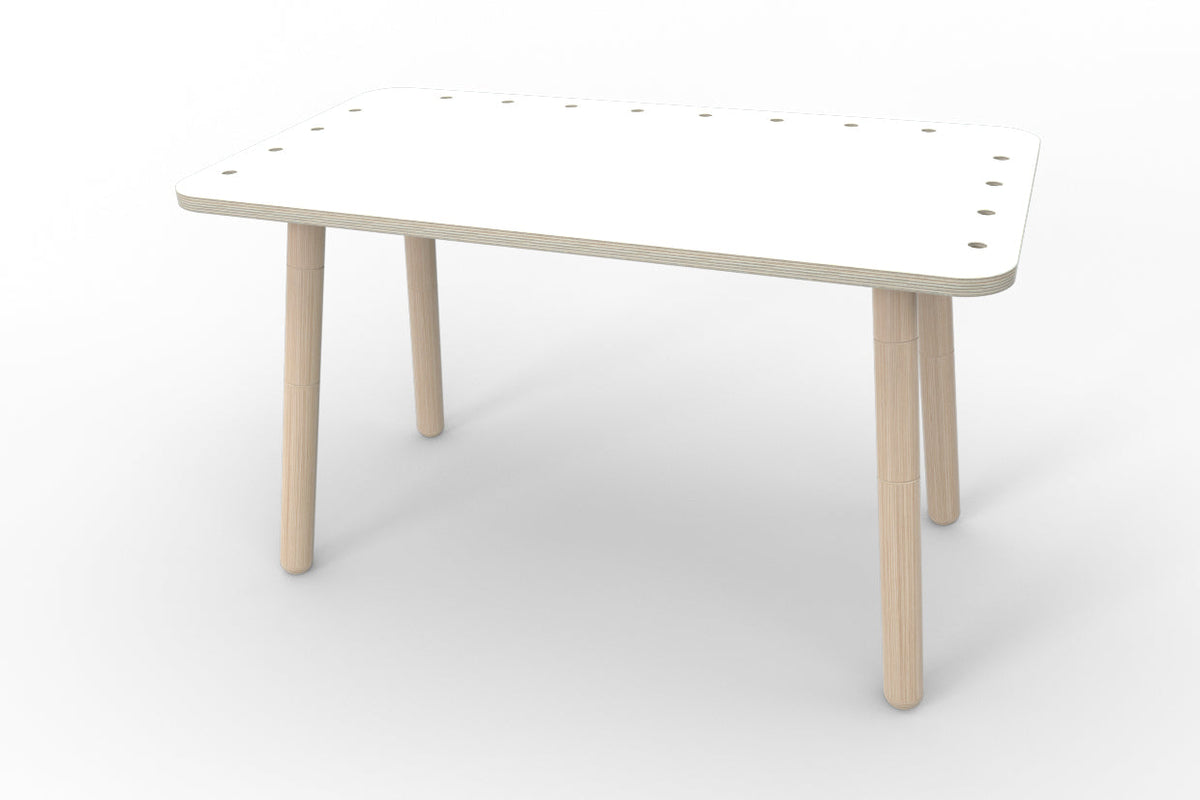
Check the lowest and highest settings of the desk. The growing table kids' desk by Pure Position can be set to 42, 52, 62 and 72 cm. According to the manufacturer, it can be used from about 2 years, and at the highest setting it also suits school kids.
2. How the height is adjusted
There are cranks, gas springs and screw systems. On the growing table, the height is set in four fixed steps using a screw system on the legs. It's not for quick changes in everyday use, but the desk stands firmly at every setting.
3. Enough space on the desktop
Drawing, crafts and, later, notebooks, books and a laptop all need room. The growing table's top measures 120 × 65 cm. Evenly spaced holes hold accessories such as a pen box, book stand or paper roll holder (sold separately).
4. The right seat
An adjustable desk doesn't help much if the chair doesn't grow too. There is matching seating for the growing table:
- Stool 42 × 42 cm with seat heights from 24.5 to 44 cm, according to the manufacturer from about 2 to 3 years.
- Bench 80 × 42 cm with the same four seat heights, room for two children.
- STUDDY swivel chair with a continuously adjustable seat height from 35 to 45 cm via a gas spring, according to the manufacturer for about 6 to 16 years. Deliberately without armrests, so your child can get up easily and keep moving.
5. Material and build
A kids' desk has to stand up to glue, paint and erasers. On the growing table, the top is 24 mm multiplex, either birch with a pure white coating or oiled beech. The legs are beech and the surfaces are solvent-free. It is made in Germany by the IWL workshops for people with disabilities.
6. Reading and writing on a slope
Some desks have a tilting top. If you'd like a sloped surface for reading, a book stand does the job too. On the growing table, it slots into the hole grid on the desktop.
Single pieces or a set?
If you want to set up a complete drawing and learning space right away, go for the 9-piece growing table set. It includes the desk, bench, note box, pen box, book shelf, book stand and a paper roll holder with drawing roll and tear-off bar. The set comes in pure white, oiled beech, gentian blue, May green, ruby red and sunshine yellow. A chair is not included; the stool and STUDDY are available separately.
Sitting is movement
Even at the best-adjusted desk, nobody sits still for an hour. Let your child change position, stand up and move around in between. Short breaks help more than the perfect chair.
You'll find more kids' furniture under Furniture. For toys that suit the new workspace, see our guide Montessori toys by age.
Delivery note: Pure Position furniture is shipped directly by the manufacturer. Delivery time to Germany approx. 7 to 10 business days, to the rest of the EU up to 14 business days.
Frequently asked questions
From what age is a height-adjustable kids' desk worth it?
From the toddler years, as long as the desk starts low enough. The growing table starts at 42 cm and, according to the manufacturer, can be used from about 2 years.
How high should a kids' desk be?
High enough that the elbows are level with the desktop when seated and the feet are flat on the floor. As a guide, DIN EN 1729 gives about 46 cm for children 93 to 116 cm tall and about 64 cm for 133 to 159 cm.
How often should I adjust the height?
Check it about twice a year, and whenever your child has had a growth spurt.
Do I need a height-adjustable chair as well?
Yes, the desk and seat have to match. For the growing table there's a stool and a bench with four seat heights, plus the STUDDY swivel chair with 35 to 45 cm.
Where does the growing table come from?
It is made in Germany by the IWL workshops for people with disabilities in Landsberg am Lech and shipped directly from there.